
What is a Poor Man’s Covered Call: Overview
The poor man’s covered call, also known as a diagonal debit spread, offers investors a capital-efficient alternative to the traditional covered call strategy.
Instead of purchasing 100 shares of the underlying stock, this approach involves buying a deep in-the-money (ITM) long-term call option while simultaneously selling shorter-term out-of-the-money (OTM) call options against it.
The core components of this strategy include:
- A long-term, deep ITM call option (typically 6+ months to expiration)
- Short-term OTM call options sold periodically against the long call
The primary purpose of this strategy is income generation while reducing the capital requirement compared to traditional covered calls. It allows traders to participate in a covered call-like strategy at a fraction of the cost, hence the name “poor man’s covered call.”
Market Outlook & When To Use The Poor Man’s Covered Call Strategy
It works best in neutral to moderately bullish market conditions. When you implement this strategy, you’re essentially expressing a view that:
- The underlying asset will remain stable or increase slightly in price
- The price won’t rise dramatically above your short call strike
- Implied volatility is relatively high (beneficial when selling the short calls)
This strategy is typically employed when an investor wants exposure to a higher-priced stock but lacks sufficient capital for 100 shares.
The holding period varies—the long call may be held for several months to over a year, while the short calls are typically managed on a weekly or monthly basis.
Regarding volatility considerations, this techniqye can be beneficial during periods of elevated implied volatility, as this increases the premium received from selling the short-term calls.
Strategy Structure & Mechanics
Setting Up
- Purchase a deep ITM call option with at least 6-12 months until expiration (often referred to as a LEAP – Long-term Equity Anticipation Security)
- Sell an OTM call option with a shorter expiration period against your long call
When selecting strikes, follow this:
- Long call: Choose a delta of approximately 0.70-0.80 (typically 10-20% ITM)
- Short call: Select a strike above the current stock price (typically with a delta of 0.30 or less)
For expiration considerations:
- Long call: Typically 6-12+ months out
- Short call: Usually 30-45 days out, though some traders use weekly options
Example Setup
Let’s say you’re interested in a stock trading at $100 per share. Instead of purchasing 100 shares for $10,000, you could:
- Buy a 9-month $80 call option (deep ITM) for approximately $2,500
- Sell a 1-month $105 call option for $200
Your initial investment would be $2,300 ($2,500 – $200), representing a 77% reduction in capital compared to buying the shares outright.
Risk/Reward Profile
Maximum Profit Potential
The maximum profit for this strategy occurs when the stock price is exactly at the short call strike price at expiration. It can be calculated as:
Max Profit = Short Call Premium + (Short Call Strike – Long Call Strike) – Net Debit Paid
Maximum Loss Potential
The maximum loss is typically limited to the net debit paid for the position (cost of long call minus premium received for short call). This occurs if the underlying stock price falls significantly and both options expire worthless.
Break-Even Point
The break-even point at expiration of the long option can be calculated as:
Break-even = Long Call Strike + Net Debit Paid
Strategy Diagram
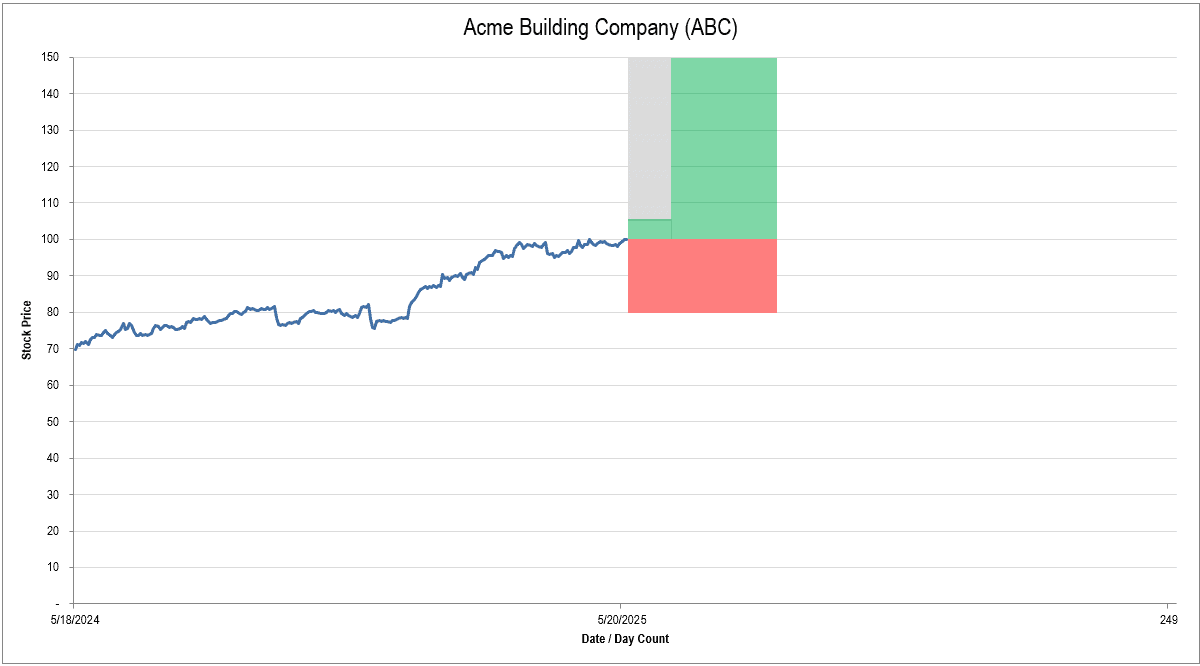
This visual representation helps you understand the risk/reward tradeoff and see why this technique is considered a capital-efficient alternative to the traditional covered call strategy.
Understanding the Diagram
Here’s how to interpret the diagram:
-
Buying an In-the-Money call option
-
Selling a call option
- Effective Entry Price for a Covered Call on ABC = $100 / share – $2 / share (in option premium) = $98 / share.
- Effective Entry Price for a Poor Man Covered Call on ABC = $20.05 / share (in option premium paid for the call option) – $2 / share (in option premium) = $18.05 / share.
Mathematical Examples
Imagine a scenario with a stock trading at $100:
- Buy a 9-month $80 call for $25 ($2,500)
- Sell a 1-month $105 call for $2 ($200)
- Net debit: $23 ($2,300)
Let’s examine various price scenarios at the expiration of the short call:
Scenario 1: Stock at $95
- Short $105 call expires worthless (keep $200 premium)
- Long $80 call is worth approximately $15 ($1,500)
- Position value: $1,700
- Unrealized P/L: -$600 ($1,700 – $2,300)
- You can sell another call for the next month
Scenario 2: Stock at $105
- Short $105 call expires at breakeven (keep $200 premium)
- Long $80 call is worth $25 ($2,500)
- Position value: $2,700
- Unrealized P/L: +$400 ($2,700 – $2,300)
Scenario 3: Stock at $120
- Short $105 call is $15 in-the-money (-$1,500)
- Long $80 call is worth $40 ($4,000)
- Position value: $2,500 ($4,000 – $1,500)
- Unrealized P/L: +$200 ($2,500 – $2,300)
The break-even point at the final expiration of all options would be $103 (Long call strike $80 + net debit $23).
Greeks Impact Analysis
Delta
The poor man’s covered call typically begins with a positive delta (around 0.50-0.60), meaning it benefits from increases in the underlying price—up to a point. As the stock approaches and exceeds the short strike, the position’s delta approaches zero due to the offsetting deltas of the long and short calls.
Theta (Time Decay)
This strategy benefits from time decay in the short call position while simultaneously being hurt by time decay in the long call. However, the rate of decay is greater in the short-term short call, creating a net positive theta effect when managed properly. The theta benefit increases as the short call approaches expiration.
Vega (Implied Volatility)
This strategy has negative vega exposure, meaning it generally benefits from decreasing implied volatility. This occurs because the long-term option typically has higher vega than the short-term option. Therefore, a decrease in implied volatility will hurt the long call more than it helps the short call.
For volatility skew, if the implied volatility of the short-term options is higher than that of longer-term options, this can be advantageous when initiating the position.
Gamma
Gamma risk is most pronounced when the stock price approaches the short call strike near expiration. At this point, the position can experience rapid changes in delta, potentially leading to larger-than-expected gains or losses with small movements in the underlying price.
Strategy Adjustments
When the Stock Price Rises Significantly
If the underlying approaches or exceeds your short strike:
- Roll up and out: Buy back the short call and sell another at a higher strike and/or later expiration
- Convert to a call debit spread: Consider closing the position or adjusting to capture some profit
When the Stock Price Falls
If the underlying declines:
- Roll down: Buy back the short call (now cheaper) and sell another at a lower strike to collect additional premium
- Evaluate the long call: Determine if it’s worth maintaining the position or if closing it entirely makes more sense
Volatility Changes
- Increasing volatility: Consider selling calls with shorter duration to capitalize on higher premium
- Decreasing volatility: Consider selling calls further out in time to collect more premium
Rolling Techniques
Rolling involves closing the current short option and opening a new one. Common rolling approaches include:
- Roll out: Same strike, later expiration
- Roll up: Higher strike, same expiration
- Roll up and out: Higher strike, later expiration
- Roll down: Lower strike, same expiration
Exit Strategies
Optimal Exit Scenarios
Consider exiting the entire position when:
- You’ve collected 50-75% of the maximum potential profit
- The underlying has reached your price target
- Your market outlook has changed
Risk Management
Establish exit points based on:
- Maximum acceptable loss (often 50-100% of the initial credit received)
- Technical support/resistance levels
- Changes in the underlying’s fundamentals
Early Exit vs. Holding to Expiration
Many traders close the short call when they’ve captured 50-80% of the maximum premium rather than holding until expiration. This reduces risk and allows capital to be redeployed.
For the long call leg, consider holding as long as your bullish thesis remains intact or rolling it forward as expiration approaches.
Assignment Considerations
If the stock price exceeds your short call strike near expiration, be prepared for potential assignment. In this case, you would need to either:
- Exercise your long call to provide the shares (if assigned)
- Buy back the short call before expiration to avoid assignment
- Allow assignment and then purchase shares in the market to satisfy the obligation
Advantages
The poor man’s covered call offers several compelling benefits:
- Significantly reduced capital requirement compared to traditional covered calls
- Lower maximum loss than owning the stock outright
- Ability to generate recurring income through multiple short call sales
- Potential for higher percentage returns on capital
- Defined risk limited to the net debit paid
- Flexibility to adjust as market conditions change
Disadvantages & Risks
Despite its advantages, this strategy has important drawbacks:
- Limited profit potential compared to simply owning the stock
- Higher complexity requiring more active management
- Exposure to volatility risk (particularly vega risk)
- Potential early assignment risk on the short call
- Time decay working against the long call position
- Risk of the underlying stock falling sharply
- Additional transaction costs from multiple option trades
Tax Considerations
This options strategy can have complex tax implications:
- Options held for less than a year are typically taxed as short-term capital gains
- The strategy may involve both short and long-term gains
- Assignment of options can create taxable events
- Wash sale rules may apply when rolling positions
Note that individual tax situations vary, and it’s advisable to consult with a tax professional for guidance specific to your circumstances.
Who Should Consider This Strategy
It is best suited for:
- Intermediate to advanced options traders
- Investors with moderate risk tolerance
- Traders with sufficient knowledge of options mechanics and Greeks
- Investors looking to reduce capital requirements while generating income
- Those willing to actively manage positions (this is not a “set and forget” strategy)
Most brokerages require at least Level 3 options approval to implement this strategy.
Related Strategies
Similar Strategies
- Traditional Covered Call: Higher capital requirement but simpler to manage
- Call Credit Spread: Lower capital requirement but less income potential
- Calendar Spread: Similar structure but different market outlook
- PMCP (Poor Man’s Cash-Secured Put): A capital-efficient alternative to selling cash-secured puts
Comparison with Traditional Covered Call
| Poor Man’s Covered Call | Traditional Covered Call | |
| Capital Required | Lower (30-40% of stock price) | Higher (100% of stock price) |
| Maximum Loss | Limited to net debit | Potentially larger (stock can go to zero) |
| Profit Potential | Slightly lower | Slightly higher |
| Complexity | Higher | Lower |
| Management Required | More active | More passive |
Common Mistakes to Avoid
- Using too little time on the long call: Ensure your long call has at least 6+ months until expiration to minimize theta decay
- Improper strike selection: Choosing a long call without enough delta or a short call with too much delta
- Ignoring volatility conditions: Failing to consider implied volatility when entering positions
- Over-allocation: Risking too much capital on a single position
- Poor management of winners/losers: Not taking profits or cutting losses at appropriate times
- Neglecting assignment risk: Failing to monitor positions as expiration approaches
Frequently Asked Questions
Q: Why is it called a “poor man’s covered call”?
A: The name comes from its significantly lower capital requirement compared to a traditional covered call, making it accessible to traders with smaller accounts.
Q: How often should I roll the short call?
A: Typically, traders roll when they’ve captured 50-80% of the maximum premium or when the short call approaches expiration.
Q: What happens if I’m assigned on my short call?
A: If assigned, you can exercise your long call to fulfill the obligation, though this will close your entire position. Alternatively, you can buy back the short call before expiration to avoid assignment.
Q: How do I adjust if the stock price falls significantly?
A: You can roll your short call down to a lower strike to collect more premium, though this reduces your protection. In severe cases, you might consider closing the position to prevent further losses.
Glossary of Terms
- LEAP (Long-term Equity Anticipation Security): Options with expiration dates further than 9 months in the future
- Diagonal Spread: An options spread with different strike prices and different expiration dates
- Rolling: Closing an existing option position and simultaneously opening a new one with different terms
- Assignment: When the holder of a short option position is obligated to fulfill the terms of the option contract
Conclusion
Okay! Got all that? It’s a lot, I know.
I can’t tell you how much easier this would be if you really understood how options worked and could look at them in a new way.
We have information in our curriculum that teaches you everything you need to know—how option pricing models work (and why long time-horizon investors have a natural advantage in option markets), what “the Greeks” are (and which is
the most important one to pay attention to), and why leverage is such a powerful
(but double-edged) sword to wield as an investor.
Our full courses are expensive (and are worth every penny) but here is an Introductory free course on option investing to give you an idea of our approach.
Once you’re ready, take one of our Expert-led courses to master option investment/trading!
You will feel more confident and be more successful when you really understand
how to use these powerful tools!May the balance of risk and reward always tilt in your favor!
Remember that the successful implementation of this strategy requires ongoing option education, practice, and disciplined risk management.
Disclaimer: This content is provided for educational purposes only and is not investment advice. Options trading involves risk and may not be suitable for all investors. Consult with a qualified financial advisor before making investment decisions.
